
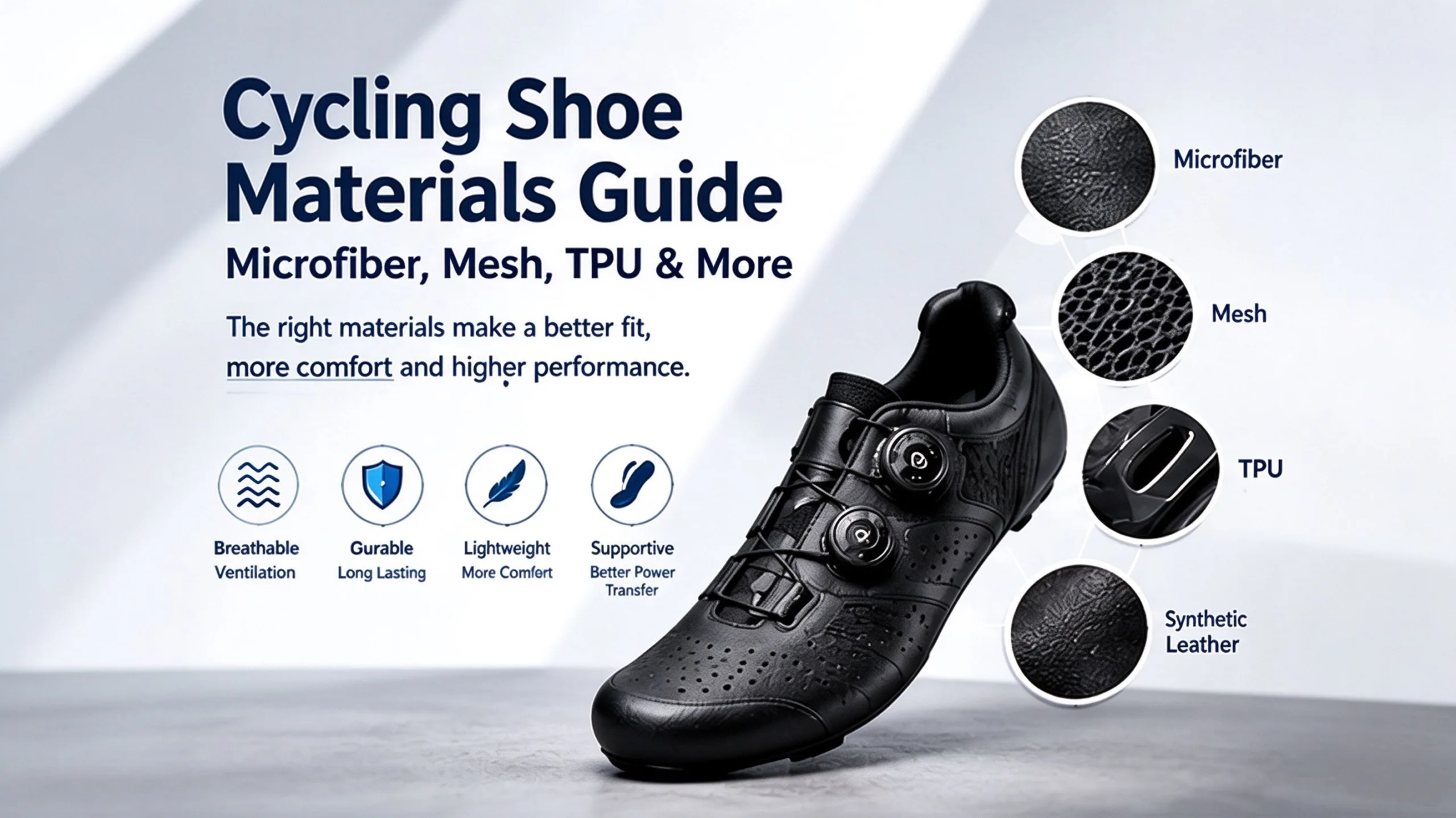
Choosing a cycling shoe is not only about the sole stiffness, cleat system, closure or size. The materials used in the upper can have a major influence on how a cycling shoe feels, fits, ventilates and performs over time.
So, what are the best cycling shoe materials?
There is no single material that is best for every rider or every type of cycling shoe. Road racing shoes may prioritize lightweight construction, support and efficient power transfer, while MTB shoes may require additional protection and durability. Indoor cycling shoes often place greater emphasis on ventilation and comfort.
The most common materials used in modern cycling shoe uppers include microfiber, mesh, TPU, synthetic leather and combinations of several materials.
In this guide, we explain the differences between these materials, where they are normally used, and how brands can choose the right material combination when developing custom or private label cycling shoes.
Quick Answer: Which Cycling Shoe Material Is Best?
For most modern performance cycling shoes, a combination of materials is more practical than using one material throughout the entire upper.
- Microfiber: good balance of support, durability and a clean premium appearance
- Mesh: excellent for ventilation and lightweight construction
- TPU: useful for reinforcement, abrasion resistance and structural support
- Synthetic leather: suitable when a smoother appearance, durability and structured support are important
- Material combinations: allow manufacturers to place different properties in different areas of the shoe
For example, a cycling shoe may use microfiber around the main upper, mesh in ventilation zones and TPU around high-wear or reinforcement areas.
This type of zonal construction is already used by major cycling footwear brands. Shimano, for example, describes road shoe constructions combining synthetic leather, mesh and TPU elements, while other performance models use different upper structures depending on the rider’s needs.
What Are Cycling Shoe Uppers Made Of?
The upper is the part of the cycling shoe that surrounds and holds the foot.
Unlike casual footwear, cycling shoes need to balance several requirements at the same time:
- Foot support
- Secure fit
- Ventilation
- Flexibility in selected areas
- Abrasion resistance
- Low weight
- Moisture management
- Compatibility with the sole and closure system
This is why manufacturers rarely rely on one material for the complete upper.
Instead, different materials can be combined according to the function of each area.
For example:
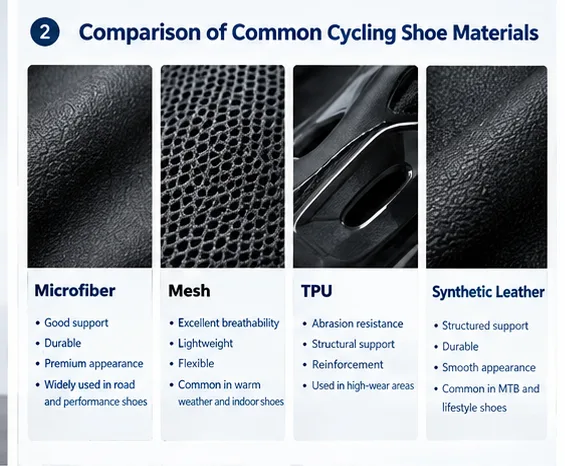
| Material | Main Strength | Common Application |
|---|---|---|
| Microfiber | Support + durability | Road, MTB, performance shoes |
| Mesh | Breathability + low weight | Ventilation zones, tongue, forefoot |
| TPU | Reinforcement + abrasion resistance | Toe, heel, side panels |
| Synthetic leather | Structure + appearance | Performance and lifestyle shoes |
| Material combinations | Balanced performance | Most modern cycling shoes |
The exact result depends not only on the material itself, but also on thickness, density, lamination, perforation, stitching, bonding and the shape of the shoe last.
Microfiber Cycling Shoes
What Is Microfiber?
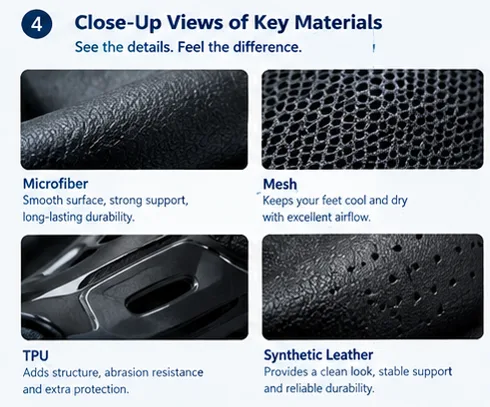
Microfiber is a synthetic material made from extremely fine fibers. In cycling footwear, it is often used as an alternative to traditional leather because it can provide a relatively smooth, consistent surface while allowing manufacturers to control thickness, texture and construction.
Microfiber is particularly common in performance-oriented cycling shoes.
For example, Shimano’s high-performance road shoes use microfiber upper constructions, including reinforced breathable microfiber in certain models.
Advantages of Microfiber
1. Good structural support
Microfiber can provide a relatively stable upper structure, which is useful when the shoe needs to hold the foot securely during high-force pedaling.
2. Durable surface
Depending on the specific material specification and construction, microfiber can provide good resistance to normal wear.
3. Clean appearance
Microfiber can be manufactured with smooth or textured finishes, making it suitable for premium-looking cycling shoe designs.
4. Suitable for customization
Microfiber is commonly used for private label and OEM footwear because it can be combined with printed graphics, overlays, labels and other decorative elements.
Limitations of Microfiber
A dense microfiber upper may not provide as much natural airflow as an open mesh construction.
For this reason, manufacturers may add:
- Perforated panels
- Mesh sections
- Ventilation zones
- Tongue mesh
- Breathable lining
This creates a balance between support and ventilation.
Best Applications
Microfiber is particularly suitable for:
- Road cycling shoes
- Performance cycling shoes
- Private label cycling shoes
- Premium OEM cycling shoes
- MTB cycling shoes
- Shoes requiring a structured upper
Mesh Cycling Shoes
Why Is Mesh Used in Cycling Shoes?
Mesh is mainly associated with breathability and ventilation.
Cyclists generate considerable heat during exercise, particularly during indoor training, summer riding and high-intensity sessions. A mesh panel allows more air to move through the upper than a completely closed construction.
Shimano’s road cycling footwear, for example, uses mesh and TPU elements to improve ventilation while maintaining a secure upper structure.
Advantages of Mesh
High breathability
Open mesh structures can allow air to move through the shoe.
Low weight
Mesh can reduce the amount of dense material used in selected areas of the upper.
Flexibility
Mesh can conform more easily to foot movement in areas where a highly structured material is unnecessary.
Good for warm-weather riding
Mesh can be particularly useful for summer cycling and indoor cycling.
Limitations of Mesh
A highly open mesh may provide less protection against:
- Abrasion
- Impact
- Dirt
- Water
- Cold weather
Therefore, mesh is usually not used as the only material across the entire shoe.
Instead, manufacturers can combine mesh with more supportive or protective materials.
Best Applications
Mesh is commonly useful for:
- Indoor cycling shoes
- Summer road cycling shoes
- Ventilated road shoes
- Lightweight cycling shoes
- Tongue and forefoot ventilation panels
- Breathable MTB shoes
TPU in Cycling Shoes
What Does TPU Do?
TPU stands for thermoplastic polyurethane.
In cycling footwear, TPU is often used as a reinforcement or structural component rather than simply as the main upper material.
It can be applied to selected areas where the shoe needs additional protection, support or durability.
For example, TPU may be incorporated around:
- Toe areas
- Heel areas
- Side panels
- Lace or dial reinforcement zones
- High-wear areas
Modern cycling footwear frequently combines TPU mesh with synthetic leather or other upper materials.
Advantages of TPU
Abrasion resistance
TPU reinforcement can help protect areas exposed to repeated contact.
Structural support
It can help reinforce selected areas of the upper.
Design flexibility
TPU can be used for functional overlays as well as visual details.
Water resistance potential
Depending on the construction and formulation, TPU elements can help reduce exposure of underlying materials, although TPU reinforcement alone does not make an entire cycling shoe waterproof.
Limitations
TPU is generally not selected simply because it is “stronger.”
Too much reinforcement can make a shoe unnecessarily rigid or reduce flexibility in areas where movement is desirable.
The key is where the TPU is placed and how it is integrated with the rest of the upper.
Synthetic Leather vs. Microfiber: What’s the Difference?
The terms synthetic leather and microfiber can sometimes be used inconsistently in the footwear industry.
In practice, product specifications should describe the actual material construction rather than relying only on marketing terminology.
For buyers and cycling shoe brands, it is useful to ask the manufacturer about:
- Material composition
- Thickness
- Surface finish
- Breathability
- Abrasion resistance
- Flexibility
- Backing material
- Perforation
- Lamination
- Intended application
Two materials can both be described as “synthetic leather” while having noticeably different performance characteristics.
This is especially important for OEM cycling shoe development, because the upper material should be selected according to the shoe’s intended use rather than simply choosing the most expensive material.
Why Modern Cycling Shoes Use Multiple Materials
One of the biggest misunderstandings about cycling shoe materials is that one material should cover the entire upper.
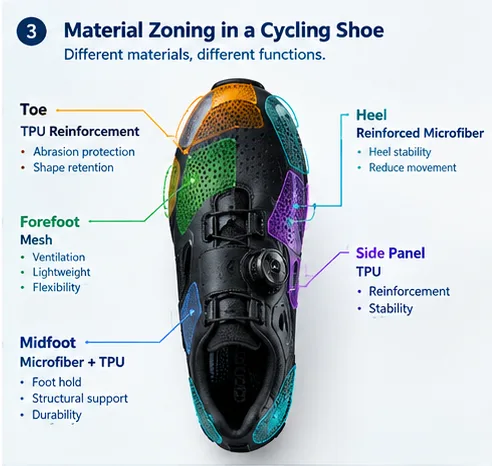
In reality, modern performance shoes often use different materials in different zones.
A simplified construction could look like this:
Forefoot
Mesh + flexible material
Purpose:
- Ventilation
- Comfort
- Flexibility
- Reduced pressure around the toes
Midfoot
Microfiber + TPU reinforcement
Purpose:
- Foot hold
- Structural support
- Closure integration
- Controlled flexibility
Heel
Structured microfiber + reinforcement
Purpose:
- Heel stability
- Reduced internal movement
- Better foot retention
Toe
Microfiber + TPU reinforcement
Purpose:
- Abrasion protection
- Shape retention
- Additional durability
This approach allows the manufacturer to balance different requirements instead of forcing one material to perform every function.
Shimano describes similar material zoning in its performance road footwear, with different materials used according to the support, flexibility and ventilation required in different parts of the shoe.
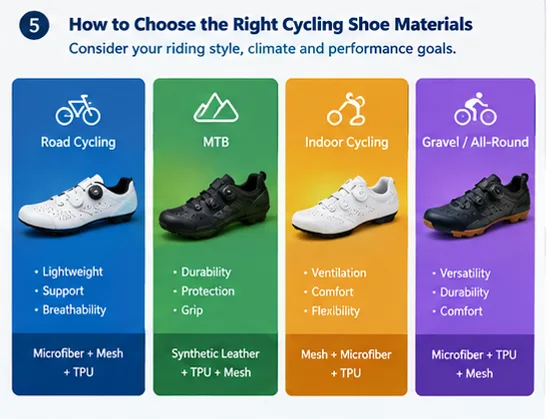
Cycling Shoe Materials by Riding Type
Different cycling disciplines create different material requirements.
Road Cycling Shoes
Road shoes generally emphasize:
- Secure foot hold
- Efficient pedaling
- Low weight
- Ventilation
- Stable upper construction
A combination such as microfiber + mesh + TPU can provide a useful balance between support and ventilation.
For high-performance road shoes, manufacturers may also use more structured microfiber and reinforced areas.
If you are comparing road shoe construction and sole stiffness, see our guide:
[Cycling Shoe Sole Guide: Carbon Fiber vs. Nylon, Stiffness, Weight & Power Transfer]
MTB Cycling Shoes
MTB footwear may require additional protection because riders can encounter:
- Rocks
- Dirt
- Mud
- Branches
- Frequent walking
- Repeated contact with the ground
Therefore, reinforced toe and heel areas can be particularly useful.
Mesh can still be used for ventilation, but the manufacturer may reduce exposed mesh in high-contact areas.
Indoor Cycling Shoes
Indoor cycling creates a different challenge.
There is no need for the same level of outdoor impact protection, but riders can experience significant heat buildup.
For this reason, breathable mesh and lightweight upper materials can be especially useful for indoor cycling shoes.
Our previous guide covers the broader selection process:
[Best Indoor Cycling Shoes for Spin Classes: Complete Buying Guide]
How to Choose Cycling Shoe Materials for a New Brand
If you are developing your own cycling shoe brand, choosing the upper material should happen before finalizing the sample, not after the shoe design has already been completed.
A practical development process is:
Step 1: Define the riding application
First decide whether the shoe is intended for:
- Road
- MTB
- Gravel
- Indoor cycling
- Casual cycling
- Commuting
- Racing
- Training
The application determines the performance priorities.
Step 2: Define the target customer
A premium racing shoe and an entry-level indoor cycling shoe may use completely different material combinations.
Consider:
- Target retail price
- Rider level
- Climate
- Expected riding duration
- Performance requirements
- Desired appearance
Step 3: Select the primary upper material
For example:
Microfiber: support and premium appearance
Mesh: ventilation and lightweight construction
Synthetic leather: structured appearance and durability
Step 4: Add reinforcement materials
TPU or other reinforcement materials can then be added to areas requiring additional protection or structure.
Step 5: Test the material combination
The final performance depends on the complete construction, not just the material specification.
A manufacturer should evaluate:
- Fit
- Flexibility
- Breathability
- Foot retention
- Abrasion resistance
- Closure performance
- Heel stability
- Overall appearance
Step 6: Confirm the production specification
Once the material combination is confirmed, the brand should document:
- Material name
- Material thickness
- Color
- Finish
- Mesh density
- TPU thickness
- Logo application
- Stitching or bonding method
- Reinforcement locations
This reduces the risk of unexpected material substitutions during mass production.
What Cycling Shoe Materials Should Brands Specify to an OEM Manufacturer?
If you are purchasing cycling shoes wholesale or developing a private label product, simply writing “high-quality microfiber” in a product specification is usually not enough.
A more useful technical specification should describe the material and its intended function.
For example:
Upper: Microfiber + Flexible TPU + Mesh Fabric
Main upper: Supportive microfiber construction
Ventilation: Breathable mesh panels
Reinforcement: Flexible TPU overlays in high-wear areas
Heel: Reinforced structure with anti-slip lining
Closure area: Reinforced material around dial attachment points
This type of specification gives the manufacturer a clearer production target.
For brands developing a new cycling shoe, the upper should also be considered together with the shoe last, outsole, closure system and intended cleat configuration.
Cycling Shoe Material Comparison
| Material | Breathability | Support | Durability | Weight | Typical Use |
|---|---|---|---|---|---|
| Microfiber | Medium | High | High | Medium | Road / MTB / Performance |
| Mesh | High | Low–Medium | Medium | Low | Ventilation / Indoor / Summer |
| TPU | Medium | High | High | Low–Medium | Reinforcement |
| Synthetic Leather | Medium | Medium–High | High | Medium | Road / MTB / Lifestyle |
| Microfiber + Mesh | High | High | High | Medium | Performance cycling |
| Microfiber + TPU + Mesh | High | High | High | Medium | Performance OEM |
Important: these are general construction characteristics. Actual performance depends on the specific material specification, thickness, density, pattern, lamination and overall shoe construction.
Does More Expensive Material Always Mean a Better Cycling Shoe?
No.
A higher-priced material does not automatically create a better cycling shoe.
The final result depends on how the materials work together.
For example, a very dense upper may provide excellent support but reduce ventilation.
Conversely, an extremely open mesh construction may provide excellent airflow but require additional reinforcement to achieve sufficient foot hold and durability.
For this reason, experienced cycling shoe manufacturers normally consider the complete upper construction rather than evaluating materials individually.
The right question is not:
“What is the most expensive material?”
A better question is:
“What material combination is appropriate for this shoe’s intended use, target price and performance requirements?”
How Material Choice Affects OEM Cycling Shoe Cost
For private label and OEM buyers, material selection also affects the commercial side of product development.
The final factory price can be influenced by:
- Material type
- Material thickness
- Material quality
- Number of upper panels
- TPU reinforcement complexity
- Mesh construction
- Printing or logo application
- Stitching
- Bonding
- Closure system
- Sole construction
- Packaging requirements
- Order quantity
A simple upper with fewer materials may be more economical to manufacture.
A more complex upper using several materials and multiple reinforcement zones can require additional cutting, stitching, bonding and assembly processes.
Therefore, design complexity and material selection should be evaluated together when developing an OEM cycling shoe.
Cycling Shoe Materials and Private Label Development
For a cycling shoe brand, material selection is also an opportunity to create a product that looks and feels different from existing market products.
Instead of simply changing the logo and color, brands can develop a differentiated upper through:
- Different microfiber finishes
- Custom mesh patterns
- TPU reinforcement shapes
- Unique panel construction
- Custom color combinations
- Branded heel structures
- Custom tongue construction
- Custom logo placement
This becomes particularly important when developing a private label cycling shoe.
If you are new to private label cycling shoes, our guide explains the complete process:
[Private Label Cycling Shoes: A Complete Guide for Brands and Retailers]
For a fully customized design, you can also read:
[From Concept to Production: How Custom Cycling Shoes Are Developed by OEM Manufacturers]
How a Cycling Shoe Manufacturer Develops a Material Combination
For a custom OEM project, material selection can follow a structured development process:
Product concept
↓
Riding application
↓
Target price
↓
Upper material selection
↓
Material zoning
↓
Prototype
↓
Fit and performance testing
↓
Material adjustment
↓
Final specification
↓
Bulk production
This is one reason an OEM manufacturer should be involved early in the development process.
Changing the material after the pattern, construction and prototype have already been finalized can affect:
- Fit
- Weight
- Flexibility
- Appearance
- Production cost
- Lead time
Early material decisions generally make the development process more predictable.
Frequently Asked Questions About Cycling Shoe Materials
What is the best material for cycling shoes?
There is no single best material for every cycling shoe. Microfiber, mesh, TPU and synthetic leather each provide different characteristics, and many modern cycling shoes combine several materials.
Is microfiber good for cycling shoes?
Yes. Microfiber can provide a useful combination of support, durability and a clean appearance, making it common in performance-oriented cycling shoes.
Are mesh cycling shoes more breathable?
Generally, mesh provides more airflow than dense upper materials. However, the actual ventilation of a cycling shoe depends on the mesh structure, perforation, lining and overall upper design.
Why do cycling shoes use TPU?
TPU is commonly used for reinforcement, structural support and abrasion protection in selected areas of the upper.
Are microfiber cycling shoes durable?
The durability of a microfiber cycling shoe depends on the specific material specification and construction. Thickness, density, surface finish, reinforcement and manufacturing quality all affect service life.
What materials are best for indoor cycling shoes?
Indoor cycling shoes can benefit from lightweight and breathable materials, particularly mesh and lightweight synthetic materials, because ventilation and comfort are often important during indoor training.
What materials are best for MTB cycling shoes?
MTB shoes often benefit from a combination of durable upper materials and reinforcement, particularly around the toe, heel and other high-contact areas, while mesh can be used in appropriate ventilation zones.
Can cycling shoe materials be customized for OEM?
Yes. For OEM and private label projects, brands can often specify different upper materials, colors, mesh constructions, reinforcement areas, logos and material combinations depending on the manufacturer’s capabilities.
Can a cycling shoe manufacturer develop a custom material combination?
Yes. During OEM development, a manufacturer can evaluate different combinations such as microfiber + mesh + TPU according to the intended application, target price and required performance.
Final Thoughts: Choose the Material for the Job
The best cycling shoe materials are not necessarily the most expensive ones.
A well-designed cycling shoe uses each material where it provides the greatest benefit.
Microfiber can provide support and durability.
Mesh can improve ventilation and reduce weight.
TPU can reinforce high-wear and structural areas.
Synthetic leather can provide structure, durability and a consistent appearance.
The most effective construction is often a combination of several materials, carefully positioned according to the needs of the rider and the intended use of the shoe.
For cycling shoe brands, this approach also provides more opportunities for product differentiation through custom upper construction, material selection and OEM development.
If you are developing a new cycling shoe brand or looking for a manufacturer that can support OEM, ODM or private label cycling shoes, material selection can be discussed together with the upper pattern, shoe last, outsole, closure system and production requirements.
Have a cycling shoe concept in mind? Contact our team with your design, reference shoe, CAD/PDF or basic requirements, and we can evaluate the material and construction options for your project.
Cycling Shoes Manufacturer in China: Complete Guide to Finding the Right OEM Supplier