Finding the right cycling shoes can be difficult if you have wide feet.
A shoe may have the correct length but still feel too narrow around the forefoot. You may experience pressure around the toes, hot spots, numbness, or discomfort after a long ride. In many cases, simply choosing a larger size does not solve the problem because cycling shoe fit depends on more than length.
For riders with wider feet, three factors deserve particular attention:
- Forefoot width and volume
- Toe box shape
- The shoe last used to build the shoe
So, what makes a good pair of wide cycling shoes?
The short answer is: a good wide cycling shoe should provide enough room around the forefoot and toes while still holding the heel and midfoot securely during pedaling.
This guide explains what to look for when choosing cycling shoes for wide feet, whether you ride road, MTB, gravel, indoor cycling, or use SPD pedals.
Quick Answer: What Should You Look for in Wide Cycling Shoes?
If you have wide feet, don’t choose cycling shoes based only on the size number.
Look for a shoe with:
- A wider or higher-volume forefoot
- A toe box that matches the natural shape of your foot
- A suitable wide cycling shoe last
- Enough room around the ball of the foot
- A secure heel and midfoot fit
- The correct cleat mounting system
- An upper that can provide support without creating excessive pressure
The goal is not to make the entire shoe loose.
Instead, the ideal fit is usually roomier where your foot needs space and secure where your foot needs support.
What Are Wide Cycling Shoes?
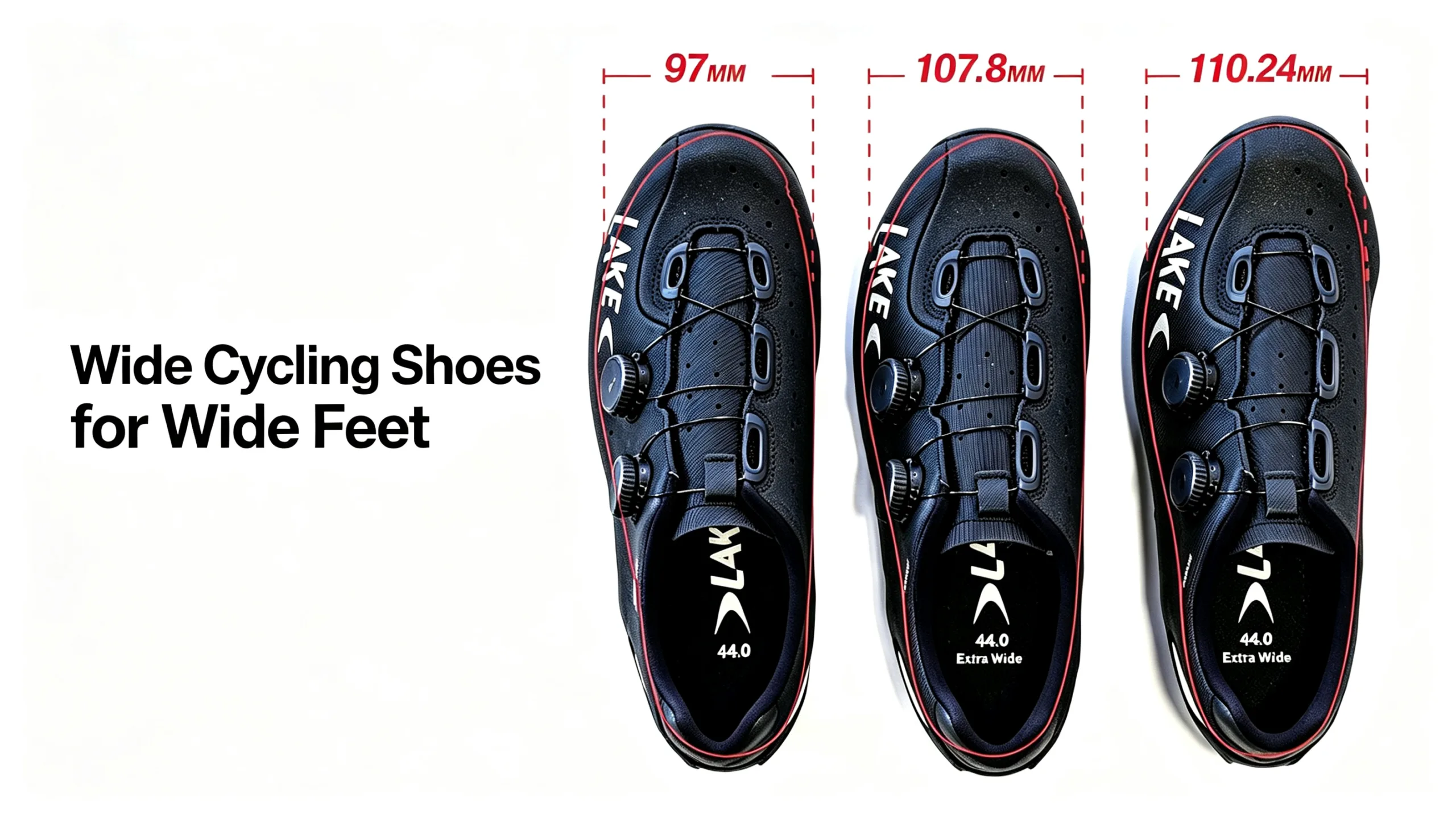
Wide cycling shoes are cycling shoes designed with additional space or volume in areas where wider feet need it, particularly around the forefoot and toe box.
However, “wide” does not always mean exactly the same thing between brands or models.
Some manufacturers increase the internal volume of the shoe. Others change the shape of the last, create a wider toe box, or offer different width options.
This means two cycling shoes with the same nominal size may feel very different on the same foot.
Wide Cycling Shoes vs. Simply Buying a Larger Size
This is one of the most common mistakes made by riders with wide feet.
Suppose your foot fits the length of an EU 42 shoe, but the forefoot feels too tight.
Moving to an EU 43 may create more room across the shoe, but it also makes the shoe longer.
That can create new problems:
- Your heel may move inside the shoe.
- Your foot may slide forward.
- Cleat positioning may no longer feel natural.
- The shoe may not hold your foot securely during hard efforts.
For this reason, increasing shoe size is not always an effective substitute for a genuinely wide fit.
The better approach is to find the correct length together with a suitable width and foot shape.
Why the Shoe Last Matters for Wide Feet
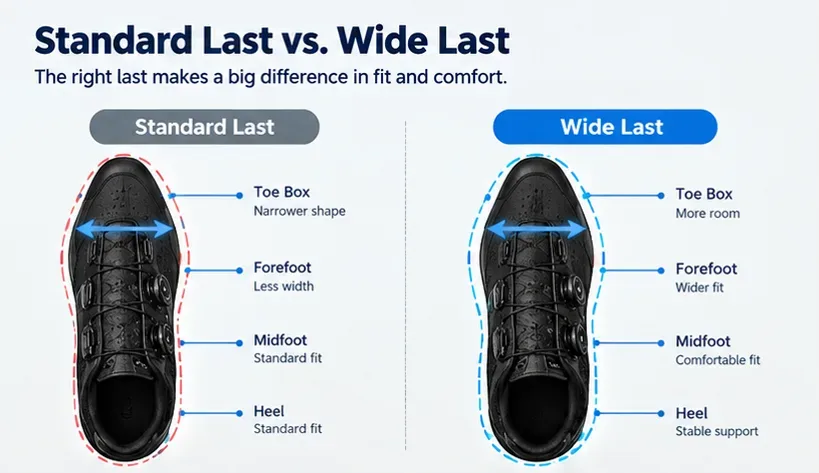
The last is the three-dimensional form around which a shoe is constructed.
It influences the shoe’s:
- Length
- Forefoot width
- Toe box shape
- Instep volume
- Heel shape
- Overall foot position
For wide-foot riders, the last can therefore be just as important as the size printed on the shoe.
A Wide Last Is More Than a Wider Sole
A common misunderstanding is that a wide cycling shoe simply needs a wider outsole.
In reality, the internal shape of the shoe matters.
A wider-fitting last may provide additional space around the forefoot while maintaining a secure heel and midfoot structure.
This is important because cycling shoes need to balance two different requirements:
Space:
Your toes and forefoot need enough room to avoid excessive pressure.
Support:
Your heel and midfoot need to remain stable so your foot does not move excessively inside the shoe.
A well-designed wide cycling shoe tries to provide both.
How Much Toe Box Space Do You Need?
The toe box should provide enough space for your toes to sit naturally without being compressed.
However, more space is not automatically better.
If the toe box is excessively large, your foot may move inside the shoe, reducing stability.
For wide feet, pay attention to these areas:
1. Forefoot Width
The widest part of your foot should not be compressed by the shoe.
2. Toe Box Shape
A rounded or appropriately shaped toe box can provide more usable space than a sharply tapered design.
3. Toe Height
Some riders need additional vertical space as well as additional width.
4. Ball-of-Foot Area
The shoe should provide enough room around the metatarsal area without allowing excessive movement.
5. Heel Fit
The heel should remain relatively secure even when the front of the shoe is wider.
This is one reason why simply making the entire shoe larger is not always the best solution.
Wide Cycling Shoes Should Not Feel Loose Everywhere
A common misconception is:
“If I have wide feet, I need a loose cycling shoe.”
Not necessarily.
Cycling shoes are designed to transfer force between your feet and the pedals. Your foot should remain stable inside the shoe.
A good wide-fit design therefore follows a simple principle:
More room in the areas that need it, secure support in the areas that don’t.
| Area | Desired Fit |
|---|---|
| Toes | Natural, not compressed |
| Forefoot | Enough width and volume |
| Midfoot | Secure but not excessively tight |
| Heel | Stable with minimal unwanted movement |
| Instep | Comfortable without excessive pressure |
| Overall shoe | Secure during pedaling |
This balance becomes especially important during longer rides.
How to Measure Your Feet for Wide Cycling Shoes
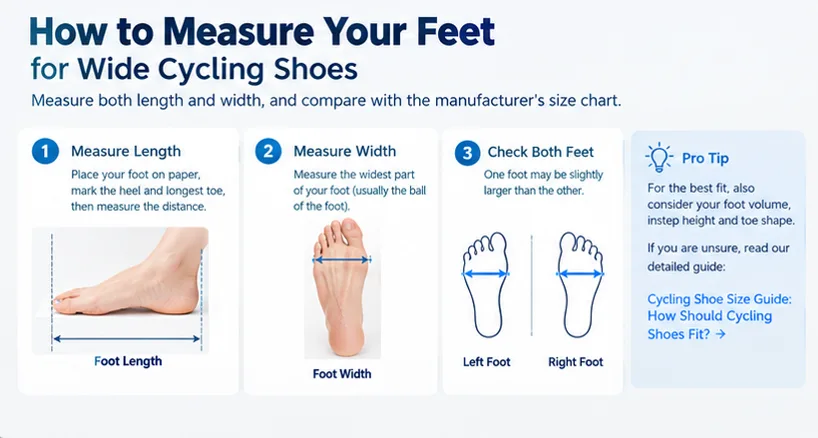
Before buying cycling shoes for wide feet, measure both length and width. (How Should Your Bike Shoes Fit?)
Step 1: Measure Your Foot Length
Place your foot on a piece of paper while standing naturally.
Mark the heel and the longest toe, then measure the distance between the two points.
Measure both feet because one foot may be slightly larger than the other.
Step 2: Measure Your Foot Width
Measure the widest part of your foot, normally around the ball of the foot.
Record the measurement for both feet.
Step 3: Consider Foot Volume
Width alone does not tell the entire story.
Two riders can have the same foot length and width but different:
- Instep height
- Forefoot volume
- Toe shape
- Arch shape
- Heel width
This is why the shape of the cycling shoe last is so important.
Step 4: Compare With the Manufacturer’s Size Information
Use the manufacturer’s size chart as a starting point.
Do not assume that your everyday sneaker size will automatically provide the same fit in cycling shoes.
For more information about general cycling shoe sizing and fit, see our guide:
Cycling Shoe Size Guide: How Should Cycling Shoes Fit?
Wide Toe Box vs. Wide Cycling Shoe: What’s the Difference?
The terms “wide toe box” and “wide cycling shoe” are sometimes used interchangeably, but they are not necessarily identical.
Wide Toe Box
A shoe with a wide toe box primarily provides additional room around the toes and forefoot.
This can be useful for riders whose main problem is pressure at the front of the shoe.
Wide Cycling Shoe
A wide cycling shoe may provide additional volume or width across a larger portion of the shoe.
This can be more appropriate for riders who have a wider or higher-volume foot overall.
Shimano DYNALAST Wide Fit Explained
Which One Do You Need?
Consider where you feel the pressure.
| Your Fit Problem | What to Look For |
|---|---|
| Toes feel squeezed | Wider toe box |
| Forefoot feels compressed | Wider forefoot |
| Instep feels tight | Higher-volume upper/last |
| Heel feels loose after sizing up | Better-fitting wide last |
| Entire shoe feels narrow | Wide-fit cycling shoe |
| Toes have room but midfoot is loose | Different last or closure design |
Wide Cycling Shoes for Road Riding
Road cycling shoes are usually designed around efficient pedaling and a secure connection between the foot and pedal.
If you have wide feet, look for a road shoe that combines:
- A suitable wide forefoot
- A comfortable toe box
- A stable heel
- Appropriate sole stiffness
- Secure closure
- Compatible road cleat mounting
The shoe does not need to feel loose simply because it is wide.
The important point is that the shoe should match your foot shape while maintaining a stable platform for pedaling.
If you are comparing road and MTB systems, our guide may also help:
SPD vs SPD-SL: What’s the Difference and Which Should You Choose?
Wide MTB and SPD Cycling Shoes
Wide-fit requirements also apply to MTB and gravel riders.
For MTB or gravel cycling shoes, riders may need to consider both foot shape and how much walking is involved.
Important factors include:
- Forefoot width
- Toe protection
- Outsole grip
- 2-bolt SPD compatibility
- Heel stability
- Upper durability
- Walking comfort
A rider who spends significant time walking may have different priorities from a road racer who spends almost the entire ride clipped into the pedals.
Therefore, the best wide cycling shoe depends not only on foot shape but also on riding style.
Wide Cycling Shoes for Indoor Cycling
Indoor cycling can create another fit challenge.
Indoor rides may involve:
- High cadence
- Long periods of continuous pedaling
- Repetitive foot movement
- Increased heat inside the shoe
- Longer periods wearing the same shoe
If your cycling shoes are too narrow, discomfort may become more noticeable during a longer indoor session.
For riders with wide feet, consider:
- A roomier forefoot
- Breathable upper materials
- Secure but adjustable closure
- Appropriate cleat compatibility
- Comfortable internal support
If you’re specifically interested in indoor cycling footwear, see our guide:
Best Indoor Cycling Shoes for Spin Classes: Complete Buying Guide
How Closure Systems Affect Wide Cycling Shoe Fit
The closure system can also influence how a cycling shoe feels on a wider foot.
Common options include:
- Rotary dial closure
- Hook-and-loop straps
- Laces
- Combination closure systems
A major advantage of an adjustable closure system is that the rider can control pressure across different areas of the foot.
For example, a shoe can provide more room around the forefoot while still allowing the midfoot and heel to be secured.
However, the closure system cannot completely compensate for an unsuitable last.
A good closure system helps fine-tune the fit; it does not replace the correct shoe shape.
For a detailed comparison of closure systems, see:
BOA vs Velcro vs Laces: Which Cycling Shoe Closure System Is Best?
Does a Stiffer Sole Work With Wide Cycling Shoes?
Yes.
Wide fit and sole stiffness are two different aspects of cycling shoe design.
A shoe can have:
- A wide last
- A stiff nylon sole
- A composite sole
- A carbon fiber sole
The correct choice depends on the intended use and rider requirements.
For a deeper explanation of sole materials and stiffness, see:
Cycling Shoe Sole Guide: Carbon Fiber vs. Nylon, Stiffness, Weight & Power Transfer
The key point is that a wider shoe does not automatically mean a less performance-oriented shoe.
The upper, last, outsole and closure system can all be designed together.
7 Signs Your Cycling Shoes May Be Too Narrow
If you are unsure whether you need wide cycling shoes, watch for these common fit problems:
1. Toe Pressure
Your toes feel compressed even though the shoe length is correct.
2. Forefoot Hot Spots
You repeatedly feel pressure in the same area around the ball of your foot.
3. Numbness
Your toes become numb during longer rides.
4. Little-Toe Pressure
The outside of your foot feels squeezed against the shoe.
5. Instep Pressure
The upper feels excessively tight across the top of your foot.
6. You Need to Size Up
You keep choosing a larger size just to get enough width.
7. Discomfort Increases During Long Rides
The shoe feels acceptable for a short ride but becomes uncomfortable after extended riding.
These signs do not automatically prove that you need a wide cycling shoe, but they are useful reasons to reassess the shoe’s width, volume and last shape.
How to Choose Wide Cycling Shoes: A Simple 6-Step Process
If you are buying cycling shoes for wide feet, use this process.
Step 1: Measure Both Feet
Record length and width.
Step 2: Identify Where the Shoe Feels Tight
Is the problem at the toes, forefoot, instep or entire shoe?
Step 3: Look at the Last
Check whether the manufacturer offers a wide or high-volume last.
Step 4: Check the Toe Box
Make sure your toes have enough room without excessive movement.
Step 5: Confirm Cleat Compatibility
Check whether you need:
- 2-bolt SPD
- 3-bolt road
- Another pedal/cleat system
Step 6: Test the Fit Under Riding Conditions
A shoe that feels comfortable for five minutes may feel different after two hours.
Pay attention to pressure, movement and stability during actual riding.
Wide Cycling Shoes: Road vs. MTB vs. Indoor
The ideal wide cycling shoe can vary depending on your riding discipline.
| Riding Type | Important Wide-Fit Features |
|---|---|
| Road | Forefoot room, stable heel, road cleat compatibility, efficient sole |
| MTB | Wide toe box, foot protection, SPD compatibility, grip |
| Gravel | Forefoot comfort, walking ability, stability, durable upper |
| Indoor Cycling | Breathability, adjustable closure, forefoot comfort |
| Commuting | Comfort, walkability, secure fit, durable outsole |
This is why “the widest cycling shoe” is not necessarily the best shoe for every rider.
The correct choice is the shoe whose last, upper, sole and cleat system match both your foot and your riding needs.
Can Cycling Shoes Be Made With a Custom Wide Last?
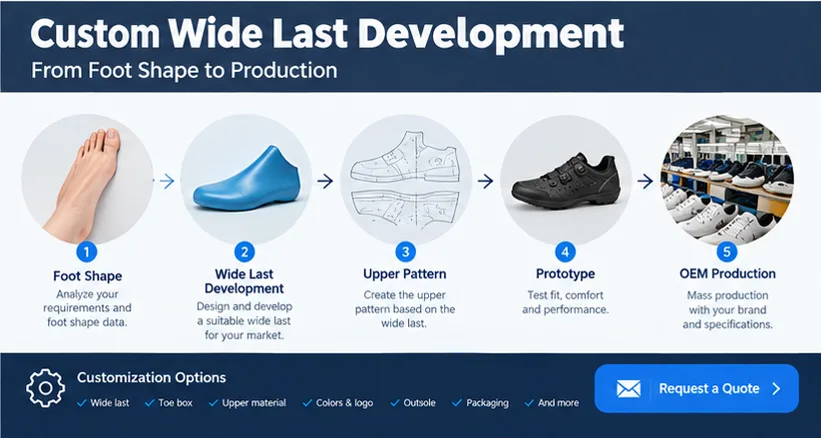
Yes.
For cycling shoe brands, retailers and distributors, a wide-foot requirement can also be addressed during product development.
Instead of simply modifying an existing shoe size, an OEM manufacturer can potentially develop a different last and upper pattern for a specific target foot shape.
Depending on the project, customization may involve:
- Wide last development
- Wider toe box
- Different forefoot volume
- Modified upper pattern
- Different heel structure
- Custom outsole
- Custom cleat mounting configuration
- Customized materials
- Private label branding
This approach can be useful for brands targeting riders who have difficulty finding suitable wide cycling shoes.
Wide Cycling Shoes for Brands and Retailers
Demand for wider cycling footwear creates an opportunity for brands and retailers that want to serve riders who are underserved by standard shoe shapes.
A brand does not necessarily need to develop a completely new cycling shoe from zero.
Depending on the required quantity and specifications, an OEM manufacturer may be able to start from an existing cycling shoe platform and customize selected elements.
Possible options include:
- Existing wide cycling shoe styles
- Customized logo
- Customized colors
- Upper material changes
- Wide toe box adjustments
- Wide last development
- Customized outsole
- New sole mold development
- Full OEM/ODM development
The right approach depends on the target market, expected order quantity and required level of customization.
For more information about developing custom cycling shoes, see:
From Concept to Production: How Custom Cycling Shoes Are Developed by OEM Manufacturers
You can also learn more about private-label programs here:
Private Label Cycling Shoes: A Complete Guide for Brands and Retailers
Frequently Asked Questions About Wide Cycling Shoes
Are wide cycling shoes better for wide feet?
If your feet are wider than the shape of standard cycling shoes, a suitable wide-fit shoe may provide a better match between your foot and the shoe. The important factor is not simply the word “wide” but whether the shoe’s last and internal volume match your foot shape.
Should I size up if cycling shoes are too narrow?
Not necessarily. Sizing up increases length as well as width. If the length is already correct, a genuinely wider last may provide a better solution.
What is the most important part of a wide cycling shoe?
For many riders, the forefoot and toe box are critical areas. However, the entire last matters because the heel, midfoot, instep and forefoot all affect overall fit.
Do wide cycling shoes reduce pedaling performance?
A wide fit does not automatically reduce performance. A properly fitted cycling shoe should provide enough forefoot room while keeping the heel and midfoot secure.
Can road cycling shoes be wide?
Yes. Wide-fit road cycling shoes are available, and road shoes can be designed around different foot shapes and forefoot volumes.
Can MTB cycling shoes be wide?
Yes. Wide-fit MTB and gravel cycling shoes are also available. When choosing one, consider both foot width and outsole requirements for walking and off-road use.
What is a wide cycling shoe last?
A wide cycling shoe last is a three-dimensional shoe form designed to provide additional space or volume for wider foot shapes. It influences the forefoot, toe box, instep, heel and overall internal geometry of the shoe.
Can an OEM factory develop a custom wide cycling shoe?
Yes. Depending on the project, an OEM manufacturer can potentially develop a custom wide last, upper, outsole and other components for a cycling shoe brand.
Final Takeaway: Wide Cycling Shoes Are About Foot Shape, Not Just Size
If you have wide feet, choosing cycling shoes should go beyond simply asking:
“What size do I wear?”
A better approach is to consider:
Foot length + foot width + forefoot volume + toe box shape + shoe last + closure + cleat system.
The right wide cycling shoes should give your forefoot enough room while maintaining a secure heel and midfoot fit.
For individual riders, the best starting point is to measure your feet and identify where your current shoes create pressure.
For cycling brands and retailers, a more customized approach may involve developing a dedicated wide cycling shoe last or wide toe box design for your target market.
If you are looking for a cycling shoe manufacturer that can support wide-fit, private-label or custom cycling shoe development, contact our team to discuss your requirements, target foot shape, cleat system and expected quantity.